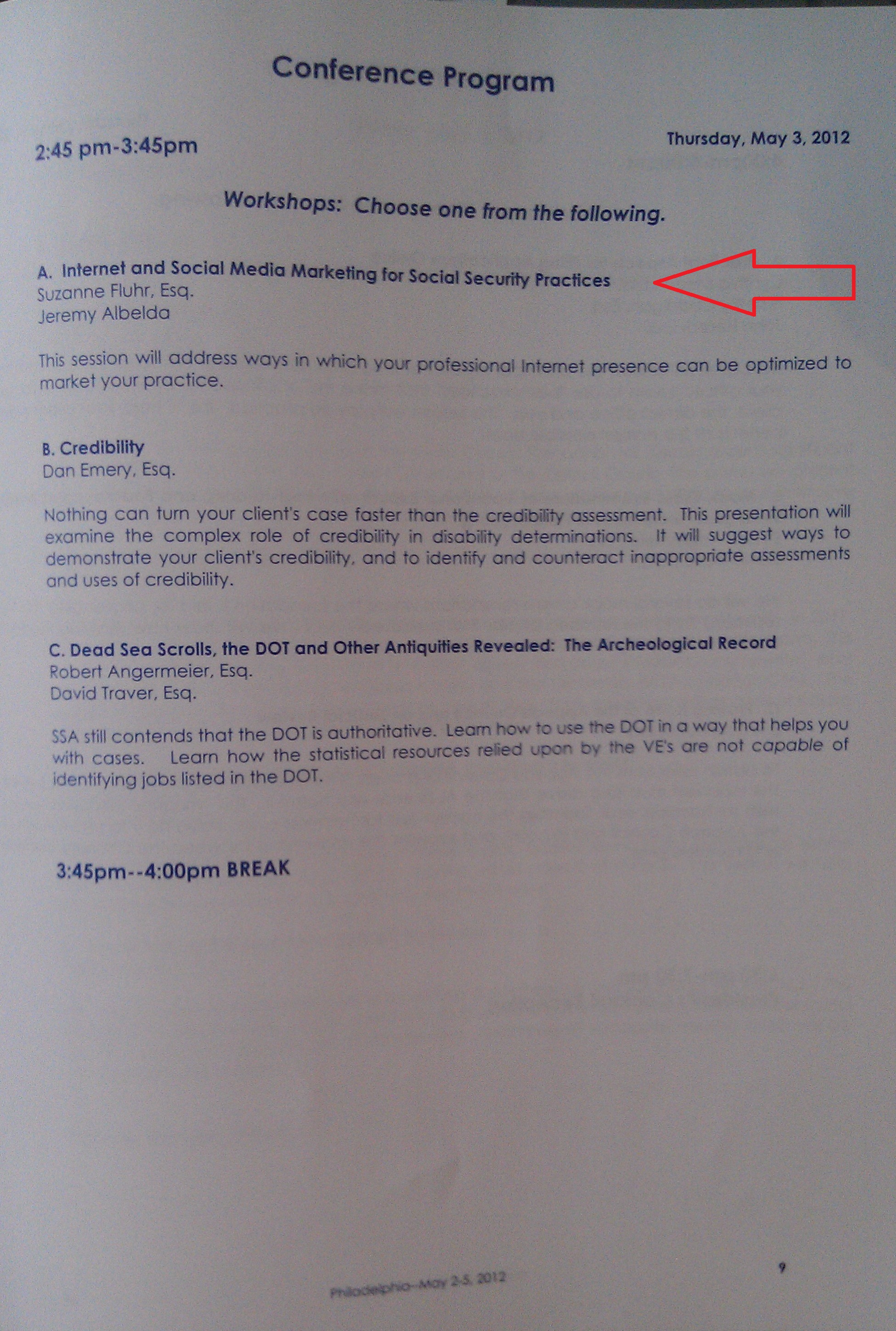
Team WriteThatRight is presenting on Internet Marketing at the NOSSCR Conference 2012!

So, after a bit of luck and building a name in the world of internet marketing, part of the Write that Right team will be heading to Philadelphia on May, 3rd to present about internet marketing and social media for social security attorneys.

We’re expecting a crowd of about 3-400 for our presentation!!!!

Share This:
  • email
  • Print
  • Facebook
  • Twitter
  • LinkedIn
  • Add to favorites
  • del.icio.us
  • StumbleUpon
  • Google Bookmarks
  • Blogosphere News
  • Blogplay
  • Current
Posted in English Posts | Tagged , , | Leave a comment

Crappy English on my Favorite Chinese Restaurant’s Menu

“That Right, We do Booze Now!”

This was the menu at my favorite Chinese restaurant in Philadelphia, and while it was nothing like I saw when I visited Shanghai, I still chuckled a bit.


Share This:
  • email
  • Print
  • Facebook
  • Twitter
  • LinkedIn
  • Add to favorites
  • del.icio.us
  • StumbleUpon
  • Google Bookmarks
  • Blogosphere News
  • Blogplay
  • Current
Posted in English Posts | 1 Comment

3 Reasons You Never Reached the Interviewing Chair

Do you apply for jobs, but never hear back?

A few years ago, if you were decently qualified and applied for multiple jobs, there was a good chance you at least got an email or a call back from a few.

Today, there is such fierce competition for jobs that overqualified applicants and just that many more people in general are clawing for the same positions. This means that you most likely won’t be hearing back from most jobs you’ve tried to land.  Most career consultants will say, this is normal these days and to keep on applying and networking without becoming discouraged.  But, there are  a few things you can do to really stand out from the rest of the pack and to start that phone singing that sweet sweet “ringggggg”,  keep on reading to find out.

1. You’re just not their “Golden Child”

You might be good, but another applicant just fit’s their “Ideal Candidate” image better. When the job market is tighter than a drum head, employers have plenty of people to choose from and can usually find exactly what they’re looking for.  Don’t expect a sorry letter.

2. If they got to you, they’d like you

Employers receive so many resumes for any given job, that they would never have to use a phone book as a booster seat for their toddler again.  Ever have that friend that’s not so good looking but always has the best looking boyfriend or girlfriend?  Well, do what they do!  The more people you send your resume to and the more places you network, you will eventually get noticed and receive a call back. Don’t take rejection personally, because in many instances, you never even got a look to begin with.

3. You might have got a call if you had…followed directions!

The majority of job postings online have detailed applicant procedures using wordage like “Must”, “To be considered”, and trust us, they are serious.  Do you think they are going to hire someone who can’t even follow simple instructions?  Make sure you heed any directions listed in a job posting and tailor your resume for every single job you apply for.  They want to know how you can fulfill their position, not just see what you’ve done in general.

While some of the above content might seem a little discouraging, the main point of this article is to accept that getting a job right now ain’t easy.  The best advice is to make sure your resume is flawless, you know what kind of job you’re even looking for, and as the infinitely wise Joe Dirt once said, “you just gotta keep on, keepin’ on”. If you’d like a free consultation on how to write a resume, give us a call!

Share This:
  • email
  • Print
  • Facebook
  • Twitter
  • LinkedIn
  • Add to favorites
  • del.icio.us
  • StumbleUpon
  • Google Bookmarks
  • Blogosphere News
  • Blogplay
  • Current
Posted in English Posts | Tagged , , | Leave a comment

The Difference Between SEO Copywriting and Keyword Stuffing

Attract Website Traffic While Still Writing for Human Beings

We have been increasingly receiving more and more questions from clients about Keywords and SEO Copywriting as it has become public knowledge that creating successful content is more involved than just copying and pasting the info from your brochure and plopping it on your homepage.  The super humans over at Google have created a  veritable army designing, tweaking and updating its search engine algorithms daily to stay on top of trends, finding ways to keep things more streamlined, and at the same time, accessible for people without computer science degrees to achieve some visibility.  But, some individuals have become consumed by SEO to the point that their website copy ends up sounding like the robot from the Svedka commercials created it instead of the knowledgeable business owner that they actually are.  I like to refer to websites that partake in keyword stuffing their pages as “keyword puppy mills” and while they think this might be beneficial, there’s one thing that people forget to keep in mind when creating content for a website – human beings are still on the other end reading it.

SEO Copywriting is a mixture of many things including quality content embedded with relevant links, researched keywords, and correct meta tags among others.  At the end of the day, good SEO copywriting is just downright quality writing that engages and inspires people visiting your website to contact you in order to learn more about your products, services or expertise.  If your content doesn’t accomplish that goal, then what good is having someone end up at your website?  Keyword stuffing might attract traffic, but once a viewer reads the spammy jumbled jargon present instead of fluent well-written content, you can bet their cursor will be headed for the “x” at the top-right corner of their screen.  If creating SEO content scares you, then please shoot us an email or give us a call, it’s not so bad, we promise!

Image from SEO.com

Share This:
  • email
  • Print
  • Facebook
  • Twitter
  • LinkedIn
  • Add to favorites
  • del.icio.us
  • StumbleUpon
  • Google Bookmarks
  • Blogosphere News
  • Blogplay
  • Current
Posted in English Posts | Tagged , , , , | Leave a comment

Four Tips on Boosting Your Search Enging Ranking

http://www.google.com/imgres?q=blogging&um=1&hl=en&safe=off&client=firefox-a&hs=Vhb&rls=org.mozilla:en-US:official&biw=1524&bih=924&tbm=isch&tbnid=LU_dh9Otv8ydqM:&imgrefurl=http://lsgeekster.blogspot.com/&docid=fiIaJEjYbCFB_M&w=640&h=322&ei=jYdATo2FHYTegQfy8NmoBw&zoom=1&iact=rc&dur=287&page=1&tbnh=96&tbnw=190&start=0&ndsp=35&ved=1t:429,r:23,s:0&tx=158&ty=29

Just in case you’ve been on a deserted island with no internet access for the last five years, the days when you just wanted people to find your website if they knew your web address, are most definitively OVER.  Your customers and potential customers expect to be able to “Google” any key words they remember about your business and have your website come up.  If it doesn’t, they will see the website of a competitor who is utilizing SEO (search engine optimization).  Not a good thing for you.  If they do happen to stumble upon your website, will your website engage them, or will they be leaving quickly to check out the next site that came up in their search?

If you are now sighing with grief, here are four things that will help you in creating or repairing your website and boosting your search engine ranking:

1.  You need to regularly update your website content to move your site up in search engine rankings (if you’re website is on page 11, might as well not exist).  Think about creating a blog and then make sure there are regular posts—preferably at least several times per week.  If you know you’ll never do this, think about hiring someone who will and who writes well enough that you will be proud to have their content represent you and your brand.

2.  If your market is global, make sure your website/blog is accessible in multiple languages and make sure the translations are not embarrassingly bad.  Internet translator programs are wonderful, but they are not good enough to provide the foreign language content for your website.  Keep in mind though, if most of your business is local, and you still want to reach customers who speak other languages, using a local translation service will help you make sure your translations reflect the colloquial lingo used by people in your area.  We are a Miami translation service and therefore translate content into Spanish (and vice versa) for people in Miami who primarily live and do business in Miami, which is of an international sort because of the diverse Hispanic populations that reside here.

3.  Make your website as interactive as possible without being annoying.  Talking animals that won’t shut up—probably a bad idea.  Keep your readers engaged.  Unless you’re selling nuclear reactor parts, stay away from jargon and convoluted sentences.  Make sure your audience can tell there is a walking, talking, human being eager to help them on the other side of your website/blog.

4.  Use a tool such as Google Analytics or a WordPress plug-in to provide you with data about how many and who is opening your website/blog and what they are doing once they arrive.  This will help you tweak your website/blog based on actual information.

Following these suggestions will help make your web presence a valuable asset and one that will start turning curiosity into conversions!

Share This:
  • email
  • Print
  • Facebook
  • Twitter
  • LinkedIn
  • Add to favorites
  • del.icio.us
  • StumbleUpon
  • Google Bookmarks
  • Blogosphere News
  • Blogplay
  • Current
Posted in English Posts | Tagged , , , , , | Leave a comment

Capitialization – Say What You Mean!

In a time when efficiency trumps correctness, texting and emailing  have forced most of us to “prioritize” our grammar, and one of the first things to go is usually capitalization.  For those of you who fall into this category (and we’re all guilty sometimes!), please take note of the following statement:

“Capitalization is the difference between helping your Uncle Jack off a horse and helping your uncle jack off a horse.”

Say what you mean and mean what you say!

Uncle Jack

Share This:
  • email
  • Print
  • Facebook
  • Twitter
  • LinkedIn
  • Add to favorites
  • del.icio.us
  • StumbleUpon
  • Google Bookmarks
  • Blogosphere News
  • Blogplay
  • Current
Posted in English Posts | Leave a comment

Write that Right on the Front Page of The Doral Hub!

Here’s an article written by Suzanne that made it to the front of the Doral Business Council’s Hub periodical.


Share This:
  • email
  • Print
  • Facebook
  • Twitter
  • LinkedIn
  • Add to favorites
  • del.icio.us
  • StumbleUpon
  • Google Bookmarks
  • Blogosphere News
  • Blogplay
  • Current
Posted in English Posts | Tagged | Leave a comment

The English Discount!

Share This:
  • email
  • Print
  • Facebook
  • Twitter
  • LinkedIn
  • Add to favorites
  • del.icio.us
  • StumbleUpon
  • Google Bookmarks
  • Blogosphere News
  • Blogplay
  • Current
Posted in English Posts | Tagged , | Leave a comment

The Right Word

The great American writer, Mark Twain, once famously explained that  ”The difference between the right word and the almost right word is the difference between lightning and a lightning bug.”  This is proven every day by those who travel to countries where a language other than their own is spoken.  One evening when I was an exchange student in Bogota, Colombia, I prompted quizzical looks all around the dinner table when I declared with disgust in Spanish that the movie theater I had visited that afternoon was infested with “inches”.  Not quite.  In Spanish, “pulgadas” is translated as “inches”.  As I scratched the itchy bumps on my arm, I should have been thinking of the the word “pulgas” which means “fleas”.

Sometimes, poor translation has more serious implications.  Many remember Secretary of State Hillary Clinton’s effort to get off on the right foot with her counterpart, the Russian foreign minister.  At their first meeting, she presented him with a large red “reset” button, indicating the willingness of the Obama administration to start a new era of international cooperation after a period of strained relations.  Except–oops–the translation was incorrect.  In Russian, the button did not say “reset”,  It said “overload” or “overcharge”.   Secretary Clinton’s face was as red as the button and one imagines that some translator’s head rolled.

The same “lost in translation” moments can occur even when we think we are fluent in the language we are speaking. The Irish playwright, George Bernard Shaw, is credited with pointing out that, “England and America are two countries separated by the same language.” As an American, I thought attending school in England when my father was an exchange teacher would not produce any language embarrassments.  I correctly thought that my accent might engender a few bemused comments, but I did not expect to amuse people by asking where I could find a drug store.  Apparently, I should have been looking for the “chemists”.  In school, I learned that sentences do not end with periods, but rather with full stops.  I’m afraid I just stood there looking confused when my English friend’s father asked me to put my suitcase in the boot, meaning the trunk of the car.  It sounded strange at first to be cautioned to “mind the gap” when getting off a train, instead of being urged to “watch your step”.  But, before long, I just accepted that my friend’s mother was admitted “to hospital” instead of “to the hospital”.

Proofreading my school work was a laborious task as I had to be on the look out not only for the normal mistakes, but also for words that needed to be spelled differently because this was England.  My corrections included centre for center.  Color had to be colour and we studied the British theatre–not the theater. While playfully trying to imitate an English accent with my classmates at recess, from the shocked faces, I learned that “bloody”, was considered blasphemous and a really bad word.

Spanish speakers from different home countries experience the same phenomenon.  When you go to Puerto Rico, it is okay to tell people you plan to “coger el bus” (catch a bus), but say the same thing in Argentina and expect some gasps, and for your choice of words to be corrected, since you just announced that you plan to F*** the bus!

~Suzanne

Share This:
  • email
  • Print
  • Facebook
  • Twitter
  • LinkedIn
  • Add to favorites
  • del.icio.us
  • StumbleUpon
  • Google Bookmarks
  • Blogosphere News
  • Blogplay
  • Current
Posted in English Posts | Tagged , , | Leave a comment

5 Situations that Prove Why You Should Hire a Professional Copywriter

1. You just aren’t any good at it

Talent is about 90% a function of putting in the work, but it’s hard to put the work in for something you don’t feel any connection with. Plus, sometimes you have a pressing need where you don’t have time to get good enough to do it yourself.

Lots of people hate to write. If it’s just a phobia about hitting those keys, you can try speech recognition software, which can be a fantastic time-saver. But if the thought of writing is about as appealing as dental surgery, you’ll never put the work in to get good.

Do more of what you’re good at and less of what you hate. If writing isn’t for you, hire or partner with a really good writer to make sure that part of your business is getting the attention it needs.

It doesn’t matter how fantastic your product or service is if you can’t communicate that to customers. Every company needs to communicate a powerful message — and that means you need strong writing.

2. You don’t have the bandwidth

Even if you love writing, there’s a limit to how many words we can consistently get onto the page or screen every day. Marathon writing sessions can work for some people, but they can also lead to burnout and sabotage your productivity in the long term.

Professional copywriters know “the more you tell, the more you sell.” And that’s even more true in the content marketing world — the more high-quality content you can create, the more authority and customer connection you can build.

Just realize that you need to understand the strategy behind the content you’re creating. Don’t add a writer for the sake of getting more words generated. Understand the business purpose behind all the copy you create, whether or not you do the actual writing.

3. You need particular expertise

You may create really good daily content for your blog, but you need a persuasion specialist to write sales letters that convert fans into customers.

Or you may need a subject matter expert to write a white paper.

Or a strong SEO Copywriter to write content that both serves your business needs and can rank well in search engines.

Realize that you’ll pay more for a copywriter with specific expertise, rather than a generalist … just like you pay more for a Mercedes mechanic who’s been in business for 30 years over some kid at the quickie oil change who’s always wanted to try fixing a Mercedes.

4. You’re too close to the topic

The reason it’s so hard to move from features to benefits is that it can be really tough to be objective about your own business.

You know all the blood, sweat, and tears you put in to make your product or service great. (In other words, the features of your business.) You understand the details behind the scenes.

But your customer may have no interest at all in those things. In fact, they might care deeply about something that’s barely on your radar.

Sometimes a pair of outside eyes can be just what you need to communicate your most important benefits. Your winning difference could even be something you take for granted, but that your customers find wildly impressive.

Just make sure that your writer is looking at real customer feedback. This could come from survey responses, from social media listening, or from conducting interviews with customers. Your copywriter should have direct access to real customer language about why people like doing business with you.

5. The stakes are high

If you’ve got a big launch or an important marketing campaign, you need to make sure your copy is making a great impression.

  • That means a terrific headline that gets attention immediately.
  • It means well-structured content that conveys your authority.
  • It means writing that gets to the point without a lot of fluff or verbal clutter.
  • It means customer-focused copy that clearly conveys valued benefits.
  • It means making sure you know the difference between your and you’re.

Professional copywriters are perfectionists about language. They’re obsessive about tone, subtle shades of meaning, copy structure, and the finer points of grammar and usage.

If that’s not you, you may want to bring in some help. Clunky, error-filled writing is a serious credibility killer.

But … the message still belongs to you

While a talented, well-trained copywriter can help you find your strongest possible marketing message, ultimately that message does need to come from you.

You know the customer you want to reach. You know the little details that will make your copy more interesting. No one will ever know your business like you do, and you need to recognize the hidden remarkable benefit that becomes your best marketing story.

That’s why it pays to study copywriting and marketing even if you turn over every word to someone else. A terrific copywriter can make you sound fantastic — but as the business owner, you’re the one who’s ultimately responsible for your story.

Content from Copyblogger Media

Share This:
  • email
  • Print
  • Facebook
  • Twitter
  • LinkedIn
  • Add to favorites
  • del.icio.us
  • StumbleUpon
  • Google Bookmarks
  • Blogosphere News
  • Blogplay
  • Current
Posted in English Posts | Tagged , , | Leave a comment